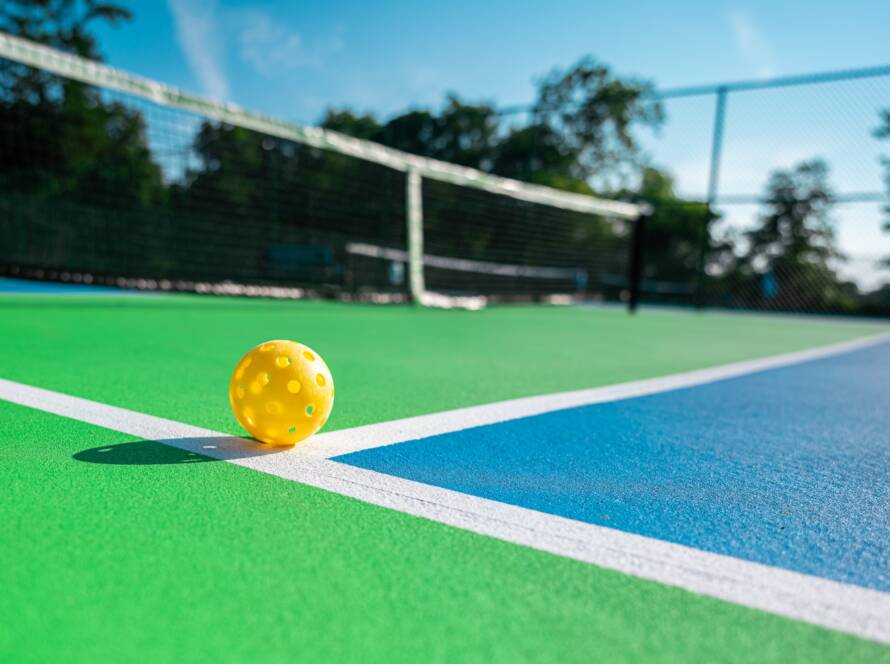
Pickleball court lines aren’t decoration — every one of them marks a rule. The baseline and sidelines define the playing area, the centerline splits each side into two service courts, and the non-volley zone line (the “kitchen” line) is the one line on the court that behaves differently from all the others. Learn what each line means and you’ll stop losing points to calls you didn’t see coming.
- Court dimensions: the lines that set the boundary
- The centerline and the service courts
- The non-volley zone (kitchen) line
- How lines decide in, out and fault
- Playing on lines that never fade
- Frequently asked questions
Court dimensions: the lines that set the boundary
A pickleball court measures 20 feet wide by 44 feet long, and that size is identical whether you’re playing singles or doubles — unlike tennis, pickleball doesn’t widen the court for doubles. The baseline is the line at each end of the court; a serve or a return that lands beyond it is out. The sidelines run the length of the court on each side and define the same thing laterally — step outside the imaginary extension of a sideline before you serve, and that’s a foot fault.
The net sits at the court’s midpoint, so each side runs 22 feet from the net back to its own baseline.
The centerline and the service courts
On each side of the net, a centerline runs from the non-volley zone line back to the baseline, splitting that half of the court into a right and a left service court. Every serve has to clear the net and the non-volley zone, then land diagonally in the correct service court on the other side — cross-court, never straight ahead.
You can work out how big each service court is from the two numbers above: the court is 20 feet wide, so the centerline splits each side into two boxes 10 feet wide. Each side runs 22 feet back from the net, and 7 feet of that (the kitchen, below) isn’t part of the service court — leaving a service box 15 feet deep.
The non-volley zone (kitchen) line
The non-volley zone, almost universally called “the kitchen,” is the 7-foot strip on each side of the net, measured from the net back toward the baseline. The line marking its outer edge is the one line on the court with a special rule attached: you cannot volley a ball — hit it out of the air — while any part of your body or paddle is touching the kitchen or its line. Momentum carrying you into the zone right after a volley counts too.
The kitchen line also governs the serve itself. A serve has to clear the non-volley zone and its line completely; a serve that lands in the kitchen, or touches the kitchen line, is a fault — even though the same ball landing on almost any other line on the court would be called good.
How lines decide in, out and fault
Pickleball follows the standard racket-sport convention: a ball landing on a line is in, not out, because the line is part of the court it marks — with the one exception above. That makes the kitchen line the single line on a pickleball court where touching it works against you instead of for you, which is exactly why it causes more disputed calls than the baseline and sidelines combined.
Foot position matters just as much as where the ball lands. On the serve, at least one foot has to stay behind the baseline and inside the sideline and centerline extensions at the moment of contact — stepping on, or over, any of those lines before you strike the ball is a fault regardless of where the serve itself lands. For the full rundown of what else turns a serve into a fault, see our guides to what makes a pickleball serve legal and the most common illegal serves, and for every other way a point can end before it starts, what counts as a fault in pickleball.
Playing on lines that never fade
Painted lines on an outdoor court wear, chalk lines wash out, and a line you can’t see clearly is a line you can’t trust mid-rally. Pickleball Athletic Club’s nine indoor, temperature-controlled, acrylic-surfaced courts in Thousand Oaks hold their lines the same way every time you book a court — no sun-bleaching, no rain, no re-chalking between sessions. If you’re weighing indoor against outdoor play more broadly, our guide to indoor vs. outdoor pickleball courts covers the rest of what changes when you move inside, and if you’re setting up a line-marked court of your own at home, our guide to playing pickleball on grass walks through marking out boundaries and a kitchen line on a surface that isn’t a dedicated court.
Ready to play on courts where the lines are always exactly where they should be? Book a court at Pickleball Athletic Club in Thousand Oaks and see the difference a true indoor line makes.
Frequently asked questions
How big is a pickleball court?
20 feet wide by 44 feet long, the same size for singles and doubles play.
What is the kitchen line in pickleball?
It’s the line marking the outer edge of the non-volley zone, 7 feet from the net on each side. You can’t volley the ball while touching it, and a serve that lands on it is a fault.
Can you step on the baseline when you serve?
No. At least one foot has to stay behind the baseline at the moment you contact the ball, or the serve is a foot fault.
Is a ball that lands on a line in or out?
In. Lines are part of the court they mark, with one exception: a serve that touches the kitchen line is a fault, even though the same line is “in” for every other shot.
Are the lines different indoors versus outdoors?
The dimensions and rules are identical. What changes indoors is how consistently the lines hold up — no fading, washing out, or repainting between sessions.