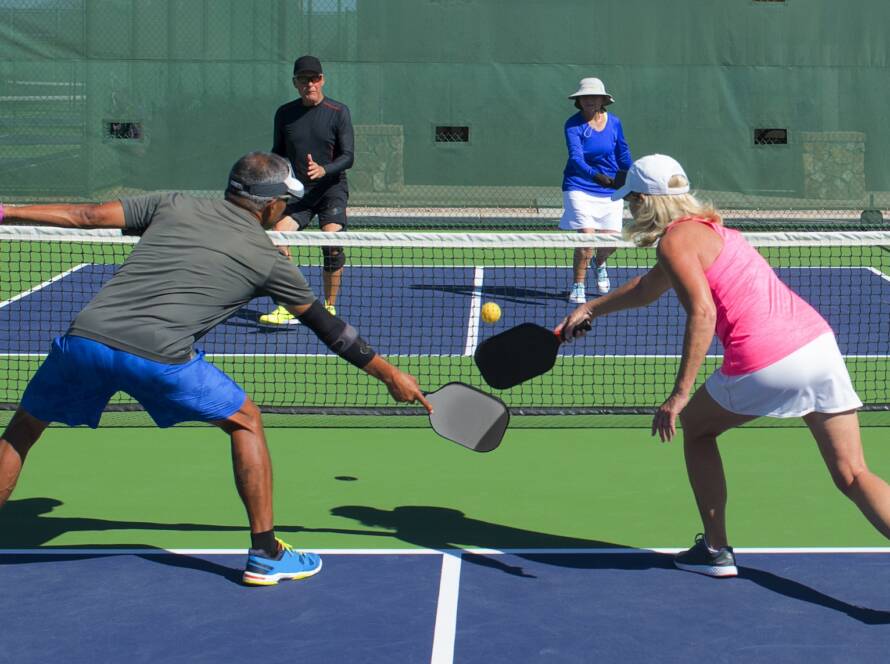
A rally in pickleball ends the instant the ball becomes dead — and that happens in exactly three ways: a fault, a clean winner the other side can’t return, or a let that stops play without deciding the point. Every point, from the serve to the last shot, is really one continuous rally until one of those three things happens. Knowing which one just occurred is the difference between calling the score correctly and arguing about it at the net. Here’s the life of a rally from serve to dead ball, who actually wins the point under traditional side-out scoring versus rally scoring, and the moments recreational players misjudge most often.
When Does a Rally End in Pickleball? The Short Answer
A rally ends the moment the ball becomes dead. That happens in one of three ways:
- A fault. A rule violation — a serve into the net, a foot fault, a shot into the non-volley zone off a volley, hitting before the two-bounce rule has been satisfied — stops play immediately. The point or the serve goes to the other side.
- A clean winner. A shot lands in bounds and the other side can’t get a paddle on it, or can’t return it in bounds themselves.
- A let. Something outside the two sides’ own play interferes — a ball rolling in from the next court, a piece of equipment on the surface. Play stops and the point replays at the same score; nobody wins or loses it.
The Life of a Rally, Serve to Dead Ball
Every rally starts the same way: a legal serve, which must bounce once in the receiving court before the returner can touch it. The return of serve must also bounce once before either side volleys it. That’s the two-bounce rule, and it’s why the first two shots of a rally always hit the ground. Once both bounces are satisfied, either side may volley the ball out of the air or let it bounce again — and the rally is live until a fault, a clean winner, or a let brings it to an end.
Nothing about that sequence changes based on how the game is scored. Side-out scoring and rally scoring award the point differently, but the conditions that end the rally itself are identical either way.
The Three Ways a Rally Ends
A Fault Ends the Rally Immediately
A fault is any rule violation, and it’s the most common way a rally ends. Stepping into the kitchen on a volley, hitting the ball before the two-bounce rule has been satisfied, or a serve that doesn’t clear the non-volley zone are all faults — the rally stops the instant it happens, with no exceptions for how good the point was up to that moment. For the full list of what counts as a fault and how each one is called, see our guide to pickleball faults.
A Let Stops Play Without Scoring the Point
A let is the rare case where the rally ends without either side doing anything wrong. If a ball from a neighboring court rolls onto the playing surface, or something else outside normal play interferes, the point is dead but nobody is charged with ending it. The rally is simply replayed from the same score and the same server.
A Clean Winner Ends the Rally on the Shot
If neither side commits a fault and nothing interferes, the rally ends when one side hits a shot the other side genuinely cannot return — in bounds, past their opponents, or into a spot they can’t reach in time. This is the rally everyone came to play: no violation, no stoppage, just one shot the other side couldn’t answer.
Who Gets the Point When the Rally Ends
This is where scoring format actually matters. Once a rally ends, the two scoring systems disagree about who’s eligible to score:
- Traditional side-out scoring. Only the serving side can score a point when the rally ends in their favor. If the receiving side wins the rally, no point is scored — instead, the serve changes hands (a side-out).
- Rally scoring. Whichever side wins the rally scores a point, whether they served or received. The serve still passes to the winning side if they weren’t already serving, but a point is awarded either way.
The conditions that end the rally — fault, winner, or let — don’t change between the two formats. Only the scoring consequence does. For the full comparison, including game length and the serve-position pattern, see our guide to rally scoring in pickleball. For a complete walkthrough of calling the score itself, see how to score pickleball.
Moments Players Misjudge Most Often
A few rally-ending moments cause more arguments than the rest combined:
- “I thought it bounced twice already.” The two-bounce rule only applies to the serve and the return of serve. Once both of those have bounced, either side can let a ball bounce as many times as they want during a rally that’s already live — a second bounce later in the point isn’t automatically a fault unless it happens after the ball has already gone dead.
- “That was still in the air.” A ball that touches any part of a player, their clothing, or anything they’re carrying ends the rally immediately as a fault — whether the shot would have landed in or out doesn’t matter once contact happens.
- “It touched the line, so it’s out.” Any part of the ball touching any part of a boundary line counts as in. Lines are good unless the ball lands entirely outside them.
When the call is close, the pickleball faults guide breaks down every specific violation in detail — this guide is about recognizing the moment the rally is over, not every way to cause it.
Playing It Out at PAC
On PAC’s nine temperature-controlled indoor courts, rallies run on their own terms — no wind pushing a ball wide, no sun in anyone’s eyes to blame for a missed call. That makes it easier to focus on the actual moment a rally ends rather than the conditions around it, which is exactly where newer players build the habit of calling faults, lets, and winners correctly and confidently. Open play and court rental are bookable directly through book.playatpac.com; see Ways to Play for open play and league options, or Coaching for lessons and clinics.
Frequently Asked Questions
Is a let the same as a fault in pickleball?
No. A fault is a rule violation charged to whoever committed it, and it ends the rally in the other side’s favor. A let is outside interference with no violation by either side, and the point is simply replayed.
Does the ball bouncing twice always end the rally?
Only during the serve and the return of serve, where a second bounce before the required one hasn’t happened yet would be a fault. Once the two-bounce rule has been satisfied, a ball is allowed to bounce again during a live rally without ending it.
Does rally scoring end rallies differently than traditional scoring?
No — the conditions that end a rally (fault, winner, or let) are identical in both formats. The difference is only in who is allowed to score the point once the rally is over. See our rally scoring guide for the full comparison.
Who makes the call when a rally ends?
In recreational and most league play, the players on the court call their own faults, lets, and line calls. Officiated tournament play uses line judges and a referee for exactly this reason — the end of a rally is sometimes genuinely too close to call from one side of the net.
What do you call the shot that ends a rally with a clean winner?
Players usually just call it a winner or a put-away — there’s no official rulebook term, but both describe the same thing: a shot the other side had no real chance to return.
Once you can call the end of a rally with confidence, the rest of the scoring system falls into place fast. Ready to put it into practice? See open play times and court options at PAC, or contact us to book a court or ask about lessons on our nine indoor courts in Thousand Oaks.