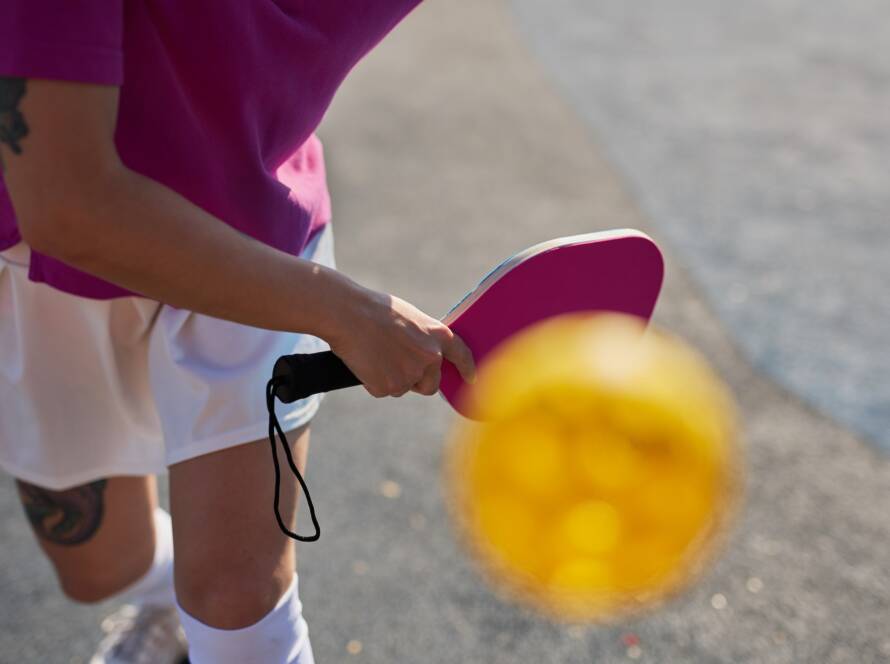
A legal pickleball serve comes down to three things: (1) serve underhand — for a volley serve, contact below the waist with an upward arm motion and the paddle head below your wrist; (2) keep at least one foot behind the baseline at contact; (3) hit the ball diagonally into the opposite service court, clearing the non-volley zone and its lines. You may release the ball from your hand or let it roll off your paddle face — but you cannot add spin during the release. Here’s every serve rule in the current USA Pickleball rulebook, what changed recently, and the faults that cost players the most points.
The three requirements of every legal serve
1. Underhand mechanics (volley serve)
For the standard volley serve — hitting the ball out of the air — all three must be true at contact:
- Contact is made below your waist (navel level)
- Your arm is moving in an upward arc
- The paddle head is below the highest part of your wrist
The overhand serve is illegal in pickleball — there is no tennis-style overhead serve.
2. Foot position
At the moment you strike the ball, at least one foot must be on the playing surface behind the baseline, and neither foot may touch the court on or inside the baseline, or outside the imaginary extensions of the sideline or centerline.
3. The target
The serve must travel diagonally into the correct service court, clearing the non-volley zone (the kitchen) and its lines. The ball may land on any other service-court line and be good — but a serve that lands in the kitchen or on the kitchen line is a fault.
Ball release: hand or paddle — but no added spin
The rulebook now allows the server to release the ball with one hand or let it roll off the paddle face. Either way, the rule is the same: “the server shall not impart manipulation or spin on the ball” during the release. Natural rotation is fine; a deliberate spin toss (the old “chainsaw” style serve) is banned. If you release off the paddle, the ball must roll off by gravity alone — no flicking or propelling.
The release must also be visible to the receiver (and referee, in officiated play). Hiding the ball behind your body or paddle can force a replay or fault.
The drop serve: the forgiving alternative
The drop serve lets you strike the ball after it bounces — and it’s exempt from the three volley-serve mechanics above, which makes it the easiest legal serve for beginners:
- Release the ball from your hand or paddle face at any natural height — you cannot throw it downward or upward to boost the bounce
- Let it bounce anywhere on the playing surface, as many times as you like
- Strike it any way you want — forehand or backhand, at any contact height
Foot-position and diagonal-target rules still apply.
Serving sequence and positioning
Singles
Your own score determines your side: even score → serve from the right, odd score → serve from the left.
Doubles
The team score and your starting side determine first and second server. Serving as the wrong server, or from the wrong side, is a fault if it isn’t corrected before the serve. Confirm order with your partner before each point — it’s the most avoidable fault in doubles.
Call the full score before serving (your score, opponent’s score, and server number in doubles), and give the receiver a moment — the rulebook recognizes “not ready” signals to prevent quick-serve disputes. How points are awarded depends on your scoring format — see our guide to rally scoring vs. traditional side-out scoring.
The five most common serving faults
- Serve lands in the kitchen (or on the kitchen line)
- Foot fault — stepping on or over the baseline at contact
- Added spin on the release — any manipulation during the toss/drop
- Propelled drop serve — throwing the ball down to get a higher bounce
- Wrong server or wrong side — a positioning fault in doubles
Quick answers
Can you serve overhand in pickleball?
No. Volley serves must be underhand (below waist, upward arc, paddle below wrist). The only exception to those mechanics is the drop serve, where the ball is struck after a bounce.
Can I toss the ball with my paddle?
You can release it off the paddle face, but only by gravity — no flicking, propelling, or spin.
Is all spin banned on serves?
No — only spin added during the release. Spin generated by your paddle at contact is legal.
Do the serve rules differ for rally scoring?
No. Scoring format changes when points are awarded, not serve mechanics — release, spin, footwork, and target rules are identical.
Know the rules but want a better serve? Start with our step-by-step pickleball serve technique guide, then have it checked against the current rulebook by a coach — PAC’s coaching programs in Thousand Oaks run daily clinics and private lessons on 9 indoor courts, and serve mechanics are lesson one.
Sources: USA Pickleball Official Rulebook, Section 4 (The Serve) · USA Pickleball Rules Summary · Pickleheads Serving Rules Guide