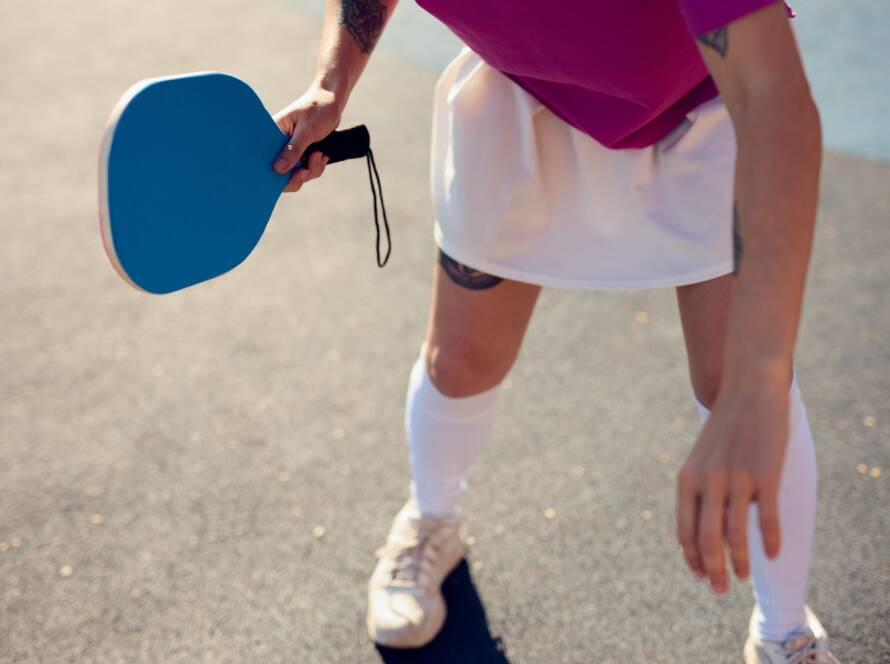
If you have played pickleball and keep hearing about padel, here is the short answer. Padel vs pickleball comes down to walls. Padel is played by pairs on an enclosed court where the ball rebounds off glass and the scoring is borrowed from tennis. Pickleball is played on an open court a little over half that size, where a seven-foot no-volley strip near the net — the kitchen — does the job the walls do in padel, and games run to 11.
They are cousins, not twins. Below is every difference that actually changes how a point plays, taken from the two sports’ own rulebooks rather than from each other. If pickleball is new to you as well, our beginner’s guide to pickleball covers the basics this article assumes. And at the end, the practical question most people are really asking: which of the two can you go and play this week?
On this page
- Padel vs pickleball: the differences at a glance
- The courts: glass walls versus the kitchen
- Balls and bats: why neither one is a tennis racket
- Serving and scoring: how a point actually runs
- Which one can you actually play?
- Padel vs pickleball: common questions
Padel vs pickleball: the differences at a glance
| Padel | Pickleball | |
|---|---|---|
| Court size | 10 m wide × 20 m long, measured inside the enclosure | 20 ft wide × 44 ft long, the same court for singles and doubles |
| Net height | 0.88 m at the centre, rising to 0.92 m at the ends | 34 in at the centre, 36 in at the sidelines |
| Walls | Enclosed by rule; the ball is played off them | None — an open court |
| Rule near the net | — | 7-ft non-volley zone; no volleying inside it |
| Ball | Pressurised rubber, bounces 135–145 cm from a 2.54 m drop | Plastic with 26–40 holes, bounces 30–34 in from a 78 in drop |
| Bat | Perforated face, holes 9–13 mm; max 45.5 cm long | Rigid face, holes not permitted; max 17 in long |
| Serve | Bounce it first, strike at or below the waist; second serve allowed | Upward arc, contact below the waist; one attempt only |
| Scoring | 15, 30, 40, game; sets to six | To 11, win by 2; only the serving team scores |
| Format | Rules are written for pairs | Singles or doubles, same court and rules |
| Governing body | International Padel Federation | USA Pickleball |
| Origin | 1969, Acapulco, Mexico | 1965, Bainbridge Island, Washington |
Read down that table and one theme repeats: padel keeps the ball alive and pickleball keeps it honest. Padel’s walls, live ball and second serve all extend a rally. Pickleball’s dead ball, single serve attempt and no-volley zone all stop anyone from ending a point with one swing.
The other thing worth noticing is the units. The two sports are governed by different bodies that publish in different systems — padel in metric, pickleball in feet and inches — so any side-by-side comparison you read is doing a conversion somewhere. The figures above are each quoted in the units their own rulebook uses.
The courts: glass walls versus the kitchen
A padel court is a rectangle 10 metres wide by 20 metres long, measured inside the enclosure, which lands at roughly 33 by 66 feet in the units most American players think in. The enclosure is not optional. The International Padel Federation’s rules state that the court “must be completely enclosed”, with the ends built to a total height of four metres — three metres of wall in glass or brick, topped by a metre of metal fence.
Those walls exist for a mundane reason. Padel was invented in 1969 at Las Brisas, in a house owned by Enrique Corcuera in Acapulco, Mexico. Corcuera was a tennis enthusiast whose backyard would not fit a tennis court, so he built a smaller one — 20 by 10 metres, enclosed by three-metre walls with a tennis net across the middle. The sport’s defining feature started life as a boundary fence.
The walls are engineered, not incidental: the rules require a material “which ensures a uniform bounce of the ball”. That predictable rebound is what makes them playable. In padel you may let the ball pass you, hit the back wall, and return it — a ball that “hits the wall in the players own court first and it then bounces into the opponent’s court” is a good return. You can also play a ball that has bounced in your opponent’s court and then run into their wall or fence. What you cannot do is hit their wall on the full: if your return reaches the opponent’s walls “without bouncing first”, you lose the point. The floor has to get there first.
Pickleball answers the same design problem — how do you stop a point ending in one shot? — without building anything. A pickleball court measures 20 feet wide by 44 feet long, and unlike tennis the same court serves singles and doubles. Each side carries a seven-foot non-volley zone, which the rulebook itself calls “the kitchen”. If you want the full dimensions, we have a guide to pickleball court dimensions.
Two rules do the work the walls do in padel. The first is the two-bounce rule: the receiving team must let the serve bounce, then the serving team must let the return bounce. USA Pickleball is explicit about why — it “eliminates the serve and volley advantage and extends rallies”. The second is the kitchen itself, where volleying is prohibited so that nobody can stand on the net and smash. Momentum counts too: if you volley and your own momentum carries you into the zone, it is still a fault, even if the ball was already dead. The one thing people get wrong is thinking the kitchen is off-limits — you may stand in it whenever you like, just not to volley. Our kitchen rules guide covers the edge cases.
Balls and bats: why neither one is a tennis racket
Almost every padel vs pickleball comparison describes this as a solid paddle against a strung racket. That is wrong, and it is worth correcting, because neither bat has strings. The real difference is the opposite of what people assume.
A padel racket’s face is required to be perforated: the rules specify a hitting surface “perforated by an unlimited number of cylindrical holes each measuring between 9 and 13 mm in the center area”, within a maximum 45.5 cm of total length, 26 cm of width and 38 mm of thickness. It also has to be tethered — a non-elastic cord of no more than 35 cm, worn around the wrist, and its use is obligatory. Lose your grip and the penalty is immediate: if a player breaks the safety cord or drops the racket, “the pair will immediately lose the point in dispute”.
A pickleball paddle is the mirror image. It must be made of “rigid, non-compressible material”, and its hitting surface “shall not contain holes, indentations, rough texturing, or any objects or features that allow a player to impart excessive spin on the ball”. Holes are mandatory on one bat and banned on the other. Size is capped by a combined measurement: length plus width may not exceed 24 inches, and length alone may not exceed 17.
The balls diverge just as sharply, and this is what you feel first. A pickleball is a plastic sphere 2.87 to 2.97 inches across, weighing between 0.78 and 0.935 ounces, with between 26 and 40 circular holes drilled through it — a specification, not a styling choice, since the hole spacing is required to conform to the ball’s flight characteristics. Drop one from 78 inches and it comes back up 30 to 34 inches. It is a deliberately dead ball.
A padel ball is a pressurised rubber sphere, 6.35 to 6.77 cm in diameter and 56.0 to 59.4 grams — close to a tennis ball in the hand, with an internal pressure between 4.6 and 5.2 kg per 2.54 square cm. Dropped from 2.54 m it bounces 135 to 145 cm. Set those two against each other and the gap is stark: the padel ball returns well over half the height it fell from, while the pickleball returns under half. One sport is built around a ball that keeps going; the other around a ball that dies.
Serving and scoring: how a point actually runs
The serve is where the two sports feel least alike, and it is the part most comparisons skip.
In padel, you bounce the ball on the ground first — there is no toss-and-strike. The rules require the server to bounce it within the box they are serving from, then hit it at or below waist height with at least one foot in contact with the ground. Waist height is judged at the moment of contact, however the server is standing, so bending your knees does not buy you a higher strike. The serve travels diagonally into the opposite service box. Crucially, if the first service is not valid the server is allowed a second service, exactly as in tennis. One quirk: a serve that lands correctly but touches the surrounding metal fence before its second bounce is a fault. In padel the walls are in play, but the fence is not, and the receiver must let the serve bounce before returning it.
Pickleball gives you one attempt and no second chance. The server’s arm “must be moving in an upward arc when the ball is struck”, contact must not be above waist level, and the paddle head must not be above the highest part of the wrist at contact. There is a sanctioned alternative — the drop serve — and if you use it, none of those requirements apply. Like padel, the serve goes diagonally crosscourt. Unlike padel, “only one serve attempt is allowed per server”. Our pickleball rules guide walks through the whole sequence.
Scoring is the other clean split. Padel scores like tennis: 15, then 30, then 40, then game, with deuce when both pairs reach three points. A set goes to six games won by at least two, a tie-break settles 6–6, and a match is the best of three sets. There is also a sanctioned short format where deuce is decided by a single “golden point”.
Pickleball’s traditional scoring is the one that confuses newcomers, because points are scored only by the serving team. Games are normally played to 11, win by 2, with tournament games sometimes to 15 or 21. Rally scoring — where a point is awarded after every rally regardless of who served — is a recognised alternative and is increasingly what you will meet in league play.
One more structural difference: padel’s rules are written throughout for pairs, with a server and a diagonally opposite receiver. Pickleball is played as doubles or singles, and the same size playing area and rules are used for both.
Which one can you actually play?
This is the honest part. For most people in the United States, the padel vs pickleball question is settled less by the rules than by what is within driving distance.
The scale of the two sports is genuinely hard to compare, because the two bodies that count players count different things. The Sports & Fitness Industry Association reports that 24.3 million Americans played pickleball in 2025, growing 171.8% between 2022 and 2025 and 479% across the five years from 2020 — figures from SFIA’s Topline Participation Report. The International Padel Federation, counting globally rather than nationally, reports approximately 35 million amateur players worldwide as of 2026, across more than 150 countries, with 100 affiliated federations. One number is American and one is worldwide, so they are not two sides of the same measurement — but the direction of travel in the US is not ambiguous.
What that means in practice: pickleball courts are close by, and padel courts mostly are not. If you are in the Conejo Valley and you want to play this week, pickleball is the one with an open door.
That is what we built. The Pickleball Athletic Club in Thousand Oaks is an all-indoor club with nine temperature-controlled courts under 25-foot ceilings — which mostly matters because nothing here is weather-dependent. Play does not move for heat, wind or rain, and an indoor surface gives the ball the same bounce in February as in August. There is open play and court rental, lessons and clinics if you are starting from zero, leagues, and DUPR-rated tournaments when you want a number next to your name.
There is a small piece of history in the building, too. The lounge here is the Bainbridge Lounge, and it shares its name with Bainbridge Island, Washington, where in 1965 three fathers — Joel Pritchard, Bill Bell and Barney McCallum — put together a game for their bored kids out of ping-pong paddles, a wiffle ball and a lowered badminton net.
If you have never held a paddle, start with what pickleball actually is, then look at the ways to play at PAC and pick the one that fits. If you are arriving from tennis rather than padel, we wrote a separate comparison on pickleball vs tennis.
Padel vs pickleball: common questions
Is padel the same as pickleball?
No. They belong to the same family of paddle sports and both are served underhand, but they are different games: padel is played on an enclosed 10 by 20 metre court where the ball rebounds off the walls and scoring follows tennis, while pickleball is played on an open 20 by 44 foot court with a seven-foot non-volley zone and games to 11.
Which is easier, padel or pickleball?
Pickleball is usually quicker to start. Its ball is deliberately dead, bouncing 30 to 34 inches from a 78-inch drop, so rallies happen at a manageable speed. Padel’s ball is pressurised and lively, and the walls add rebounds to read. Padel does give you a second serve, though, where pickleball allows only one attempt.
Should I play padel or pickleball?
In the United States, availability usually decides it. SFIA recorded 24.3 million American pickleball players in 2025, and courts are common in most towns; padel courts remain far scarcer. If both are near you, choose padel for longer rallies and tennis-style scoring, pickleball for a faster start and easier games to find.
How is padel different from pickleball?
The four differences that matter: padel’s court is enclosed and the ball plays off the walls, while pickleball’s is open; padel’s racket face must be perforated with 9 to 13 mm holes, while a pickleball paddle may not have holes at all; padel allows a second serve and pickleball allows one; and padel scores 15/30/40 while pickleball plays to 11.
Can you play padel on a pickleball court?
No. Padel’s rules require a court that is completely enclosed, with walls built into the specification, and a playing area of 10 by 20 metres. A pickleball court is open and 20 by 44 feet — smaller and without the enclosure the sport is built around. The reverse is not practical either, because the padel court’s dimensions and walls change how every shot plays.
Come and try the one that’s on your doorstep
Reading the differences only gets you so far — both sports make more sense about ten minutes into a first game. If pickleball is the one you can actually reach, the quickest way in is a beginner clinic or an open-play session, where you will be matched into games without needing to bring a partner.
See the ways to play at PAC, or go straight to PAC membership to book a court, a clinic or a first lesson in Thousand Oaks.