Pickleball is a paddle sport that blends elements of tennis, badminton, and table tennis, played with a solid paddle and a perforated plastic ball on a court about the size of a badminton court. It can be played as singles (one-on-one) or doubles (two-on-two), indoors or out, and it is widely recognized as the fastest-growing sport in the United States. If you have heard the unmistakable pop-and-dink soundtrack drifting around Thousand Oaks lately and wondered what the fuss is about, consider this your Pickleball 101 — everything a complete beginner needs to know: what pickleball actually is, how you play it, the gear you need, why it has taken off, and how to get on a court for the very first time.
What Is Pickleball?
The simplest pickleball definition: it is a paddle sport for two or four players. You use a solid paddle—larger than a ping-pong paddle, smaller than a tennis racket—to hit a lightweight plastic ball with holes over a 34-inch net. The game combines the footwork of tennis, the net play of badminton, and the hand-eye reactions of table tennis, which is exactly why it feels familiar within minutes even if you have never picked up a racket. It is often misspelled “pickle ball” or “pickel ball,” but however you write it, the appeal is the same: easy to learn, genuinely hard to master.
The sport was invented in 1965 on Bainbridge Island, Washington, by three dads—Joel Pritchard, Bill Bell, and Barney McCallum—who improvised a backyard game to keep their families entertained. Six decades later it has grown from a driveway pastime into an organized sport with a national governing body, professional tours, and a DUPR rating system. What has not changed is the low barrier to entry: the court is compact, the serve is underhand, and the pace rewards placement and patience over raw power, so players of almost any age or athletic background can rally on day one. For the official definition, rules, and history, USA Pickleball and Encyclopaedia Britannica are the authoritative references.
How Do You Play Pickleball? The Basic Rules for Beginners
Pickleball has a small handful of rules that make it distinct from tennis. Learn these four ideas—the serve, the two-bounce rule, the non-volley zone, and scoring—and you know enough to play your first game.
Serving and scoring
The serve is made underhand and diagonally to the opponent’s service court. In the traditional format, only the serving side can score a point, games are played to 11, and you must win by 2 (tournaments sometimes play to 15 or 21). In doubles, the score is called as three numbers—your score, the opponents’ score, and which server you are (1 or 2)—so “4–2–1” is a common early source of confusion that clicks into place after a game or two. Newer “rally scoring” formats, where a point is awarded on every serve, are increasingly common in leagues and social play. Because serve and scoring rules are periodically updated, it is worth checking USA Pickleball’s beginner rules guide before a tournament.
The two-bounce rule and the kitchen
Two rules give pickleball its signature rhythm. The two-bounce rule requires the ball to bounce once on each side—after the serve and the return—before either team may hit it out of the air, which keeps points from ending on serve-and-volley and sets up longer rallies. The non-volley zone, universally nicknamed “the kitchen,” is the seven-foot area on each side of the net where you are not allowed to volley (hit the ball before it bounces). The kitchen is the tactical heart of the game: it is where the soft, controlled “dinks” happen and where beginners quickly learn that touch beats power.
Pickleball Equipment: Paddles, Balls, and the Court
One of pickleball’s biggest draws is how little you need to start. The essentials are a paddle, a ball, and court access.
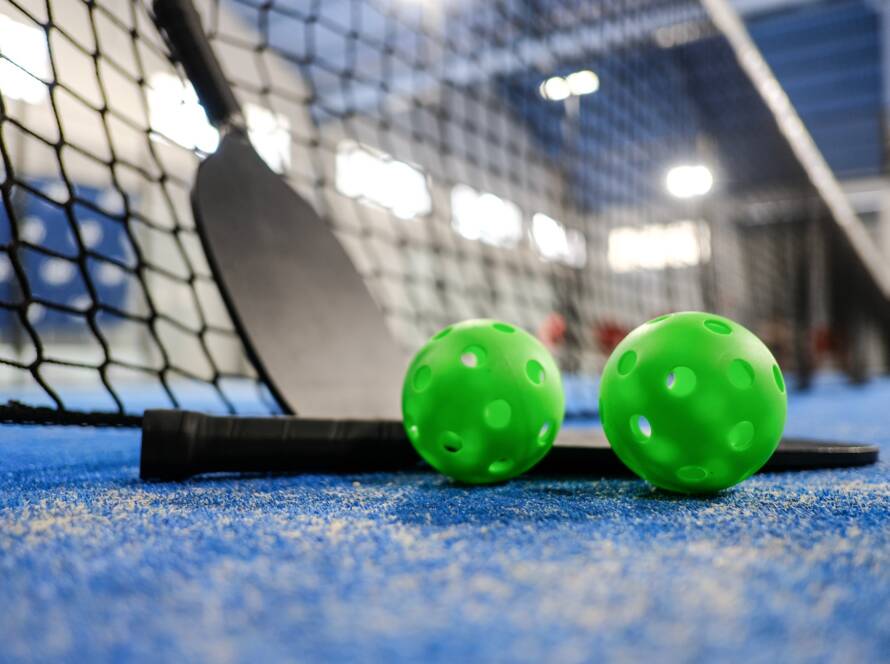
Paddles range from inexpensive wood models to composite and graphite paddles that offer more control and spin; a mid-range composite paddle is plenty for a beginner. Balls are perforated plastic and come in two types—indoor balls have larger holes and a softer flight, while outdoor balls are harder with smaller holes to handle wind. (If you are curious why that matters, we break it down in our guide to indoor vs. outdoor pickleballs.) The court is 20 feet by 44 feet—the same footprint as a doubles badminton court—with a net set to 36 inches at the sidelines and 34 inches at the center. Good athletic shoes with lateral support round out the kit. At most clubs, including ours, you can borrow or rent a paddle for your first visit, so you can try the sport before buying anything.
Why Is Pickleball So Popular—Especially Indoors?
Pickleball’s explosive growth comes down to a rare combination: it is easy to learn, deeply social, and genuinely good exercise. The compact court means less ground to cover than tennis, the underhand serve lowers the intimidation factor, and doubles play turns every session into a social event. It is also a low-impact, full-body workout that supports cardiovascular health, balance, and agility—benefits that health researchers increasingly connect to the sport’s appeal across generations. For a fuller picture of the sport’s reach, the pickleball overview on Wikipedia tracks its remarkable trajectory.
Indoor pickleball has become especially sought-after, and for good reason. Playing inside removes the two variables that most disrupt an outdoor game—wind and sun—so the ball flies true and every session feels consistent. Climate-controlled courts mean comfortable play in July heat or January chill, and cushioned indoor surfaces are easier on knees and ankles than concrete. That is the experience we built Pickleball Athletic Club around: nine temperature-controlled indoor courts with 25-foot ceilings in Thousand Oaks, so members play in ideal conditions year-round regardless of the weather outside.
Getting Started: Playing Pickleball in Thousand Oaks
The best way to understand pickleball is to play it, and getting started is easier than most beginners expect. Here is the path we walk new players through at PAC. Start with an introductory clinic — think of it as Pickleball 101 in person — where a coach teaches the serve, the two-bounce rule, and the kitchen in a low-pressure setting and puts a paddle in your hand—no equipment or experience required. From there, open play sessions let you rally with players at a similar level, and as you find your footing you can add coaching and lessons, join a league, or get a DUPR rating to track your progress and find well-matched games.
Because the sport is so social, most people improve fastest simply by showing up regularly—which is exactly what an all-indoor club makes easy. If you are in Thousand Oaks, Westlake Village, Newbury Park, or anywhere in the Conejo Valley and want to try it, our ways to play range from drop-in open play to full memberships, and beginners are genuinely welcome. When you are ready to get on a court, you can join today or book an intro session and let a coach handle the rest.
Pickleball Terms Every Beginner Should Know
Pickleball has its own vocabulary, and a few words will come up in your very first session. Knowing them makes the game far easier to follow:
- Dink: a soft shot hit from near the kitchen that arcs just over the net, forcing your opponent to hit up rather than smash down. The heart of the “soft game.”
- Volley: hitting the ball out of the air before it bounces—legal everywhere except inside the kitchen.
- The kitchen (non-volley zone): the seven-foot zone on each side of the net where volleys are not allowed.
- Two-bounce rule: the ball must bounce once on each side—after the serve and the return—before anyone may volley.
- Poach: in doubles, crossing over to take a shot that would normally be your partner’s.
- DUPR: the Dynamic Universal Pickleball Rating, the standard number used to gauge skill level and match players fairly.
Frequently Asked Questions
Why is it called pickleball?
There are two popular origin stories. One credits the inventors’ family dog, Pickles, who supposedly chased the balls; the other points to the term “pickle boat” from rowing, referring to a crew thrown together from leftover rowers—a nod to the sport’s mash-up of tennis, badminton, and table tennis. Both stories are part of pickleball lore.
Is pickleball easy for beginners?
Yes—it is one of the most beginner-friendly racket sports. The smaller court, slower ball, and underhand serve mean most people can sustain a rally within their first session, even with no racket-sport background. Mastering strategy and the soft game takes longer, which is what keeps it engaging.
What’s the difference between pickleball and tennis?
Pickleball uses a smaller court, a solid paddle, and a lighter plastic ball, and the serve is underhand rather than overhead. Rallies emphasize placement and control near the net (the “kitchen”) over the power and long-court coverage that define tennis, which makes pickleball less physically demanding and quicker to learn.
What equipment do I need to start?
Just a paddle, a pickleball, court access, and supportive court shoes. Beginners can start with an inexpensive paddle—or borrow one at a club—and upgrade later as their game develops.
Ready to Try Pickleball?
Pickleball rewards the curious: an afternoon is all it takes to learn the rules, feel the rhythm of a rally, and understand why it has become the sport everyone is talking about. The fastest way from “what is pickleball?” to your first win is simply to get on a court with a paddle and a little coaching. If you are in the Conejo Valley, come play indoors at Pickleball Athletic Club—try an open-play session or beginner clinic, and we will take it from there.