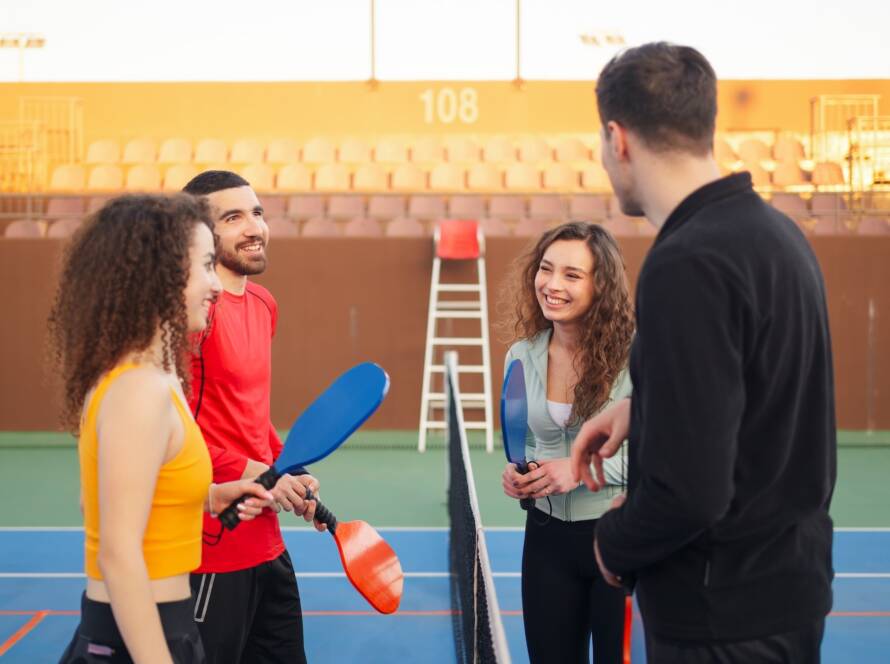
The short version of pickleball rules singles players follow: one player stands on each side, the server serves underhand and diagonally from behind the baseline, only the server can score, the score is called as two numbers, and games go to 11, win by 2. The non-volley zone, the double bounce and most faults work the same way as in doubles. This guide walks through the pickleball singles rules in the order you meet them on court: serving, scoring, the kitchen, faults and match flow.
Pickleball Singles Rules: The Complete Guide
Singles pickleball is a one-on-one version of the sport played on a standard pickleball court. Each player covers the entire court alone, which makes it more physically demanding than doubles but equally rewarding. The game follows most standard pickleball rules with a few changes for individual play.
Key Differences from Doubles
- Only one player per side
- A two-number score (server’s score, then receiver’s) instead of the three numbers called in doubles
- One server per side, with no second server
- The server’s own score decides which side to serve from
For the two-on-two version, see the complete guide to pickleball doubles rules.
Essential Singles Serving Rules
The serve starts every rally, and the same requirements apply every time:
- Underhand serve with contact below the waist/navel and the paddle head below the highest part of the wrist (a drop serve is the exception)
- Server must stand behind the baseline
- Diagonal cross-court serve required
- Serve must clear the non-volley zone
- One serve attempt per point, and no let serves: a serve that clips the net and lands in the correct service court is in play
- Drop serve option available
For the full serve rulebook, see pickleball serve rules: what’s legal and what’s a fault.
Server Positioning
In singles, the server’s own score decides the side:
- Even score: serve from the right side
- Odd score: serve from the left side
Scoring in Singles
Singles pickleball uses a straightforward scoring system:
- Games are played to 11 points (win by 2)
- Only the server can score points
- The score is called as “server’s score, receiver’s score”
- Points are earned only while serving
Example: the server leads 4-3 and wins the rally. The score is now 5-3, and because 5 is an odd number the server serves the next point from the left side. If the server loses that rally, the serve passes to the opponent.
For the three-number call used in doubles, see how to score pickleball.
Non-Volley Zone Rules
The non-volley zone (the kitchen) rules stay critical in singles:
- No volleying while standing in the kitchen
- Serves must clear the non-volley line
- You may step into the kitchen to play a ball that has already bounced
- Momentum cannot carry you into the kitchen after a volley
The Double Bounce Rule in Singles
The double bounce rule applies in singles exactly as it does in doubles: the serve must bounce before it is returned, and the return must bounce before the server volleys. The details are in the double bounce rule explained.
Common Faults in Singles Play
Watch for these common violations:
- Stepping on the baseline during the serve
- Volleying from within the kitchen
- A serve landing in the non-volley zone
- Hitting the ball out of bounds
- Touching the net during play
- Serving from the wrong side for the current score
Singles Strategy and Positioning
Effective singles play requires:
- Quick recovery to center court
- Strategic use of court depth
- Efficient movement patterns
- Balanced offensive and defensive positioning
- Awareness of your opponent’s position
Short on space or energy? Skinny singles is a half-court variant of the game.
Match Format and Progression
A typical singles match follows this structure:
- Decide who serves first
- The first server starts from the right side at 0-0, because zero is an even score
- There is no service rotation in singles: when the server loses the rally, the serve passes to the opponent
- Players switch sides between games
- A game ends at 11 points with a 2-point lead
Advanced Tips for Singles Play
- Develop consistent serve placement
- Practice efficient court coverage
- Master the dink shot for control
- Use angles to create opportunities
- Maintain physical stamina
Singles Pickleball Rules: Quick Answers
How is the score called in singles?
As two numbers: the server’s score first, then the receiver’s.
Which side do you serve from in singles?
The right side when your score is even and the left side when it is odd.
Is there a second server in singles?
No. When the server loses the rally, the serve passes to the opponent.
Is a serve that clips the net replayed?
No. A serve that clips the net and lands in the correct service court is in play.
How many points do you play to?
Games are played to 11 points, and you must win by 2.
Ready to Improve Your Singles Game?
Pickleball Athletic Club is an all-indoor pickleball club in Thousand Oaks with court rental, open play, lessons and clinics. To put these rules into practice, browse clinics and drills or the ways to play, then get in touch to ask about court time.
Playing singles in a tournament? Pickleball brackets explained covers tournament formats and seeding.