A pickleball camp is a multi-day, coach-led block of instruction that compresses what would otherwise take months of casual play into a few concentrated days. Camps come in two broad shapes: junior camps that run in school holidays and function partly as childcare, and adult camps built around a specific skill jump. Choosing well comes down to matching the format to what you actually want out of it.
Junior camps versus adult camps
They are different products and it is worth being clear about which one you are looking at.
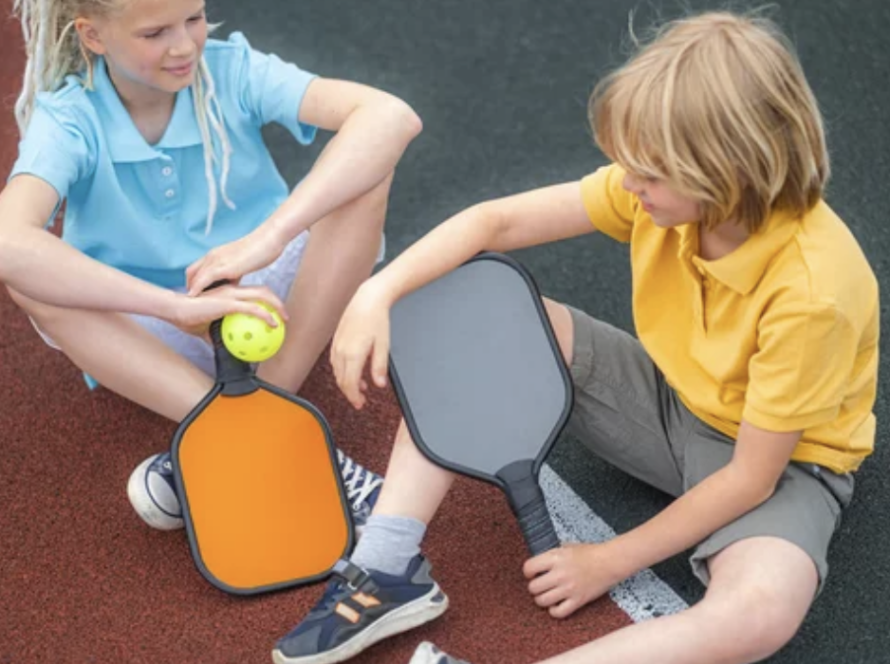
Junior camps run during school breaks, usually as full or half days across a week. Groups are split by age because a six-year-old and a thirteen-year-old need different coaching, different court sizes and different attention spans. Beyond technique, a good junior camp is teaching court awareness, rules, rotation and how to behave in a competitive game. For parents, the value is often as much about a structured week as it is about the pickleball.
Adult camps are usually shorter and more targeted: a weekend built around the third-shot drop, or a two-day intensive on transition-zone play. The people who benefit most are not beginners but players stuck at a plateau who need someone to tell them which specific habit is holding them back.
What a good camp actually covers
- Fundamentals under fatigue. Anyone can hit a clean dink when fresh. Camps expose what your technique does in hour four.
- The third shot. The single biggest gap between recreational and intermediate play, and the hardest thing to teach yourself.
- Court positioning and partner movement. Where to stand is worth more than how hard you hit.
- Live-ball games with coaching intervention. Drills matter, but skills only transfer when a coach stops a real point and shows you the decision you just made.
- Rules and scoring in context. Especially for juniors, who often learn scoring wrong and carry it for years. Our guide to scoring pickleball is a useful primer beforehand.
Questions worth asking before you book
- What is the coach-to-player ratio? This is the number that most determines whether a camp is worth the money. Large groups mean less individual correction.
- Are groups split by age or level? Both matter. A mixed-level camp tends to serve the middle and lose the ends.
- Indoor or outdoor? Multi-day camps in summer heat are a genuine consideration. Indoor courts remove the weather variable entirely, which matters more across a five-day camp than a one-hour lesson. We cover the trade-offs in indoor versus outdoor courts.
- What happens after the camp? The gains fade without follow-up. Ask whether there is a clinic or league to step into.
- What should the player bring? Court shoes matter more than paddles at this stage. See choosing shoes for pickleball.
Getting the most out of a camp
Arrive with one specific thing you want fixed. Coaches can work with players who say “my third shot floats and gets attacked” far more effectively than players who say “I want to get better”. Expect to play worse before you play better, because changing a stroke temporarily breaks it. And book something to play in afterwards, because a camp creates a window where new habits either stick or evaporate.
Camps at PAC
Pickleball Athletic Club runs junior camps through school holidays, split into two age groups so that six to nine year olds and ten to fourteen year olds get coaching pitched at them rather than at an average. Everything runs on nine indoor, climate-controlled courts, so a summer camp week is not at the mercy of an afternoon heat spike.
Current camp dates and age groups are on our youth programs page. For adults, clinics and drills and the PACademy cover the same ground in a weekly format, and one-to-one work is on our coaching page. New to the sport entirely? Start with our kids pickleball guide.
Frequently asked questions
What age can children start pickleball camps?
Around six is typical. Younger children can hold a paddle, but rotation, scoring and rally play need a level of attention that usually arrives at about that age.
Do beginners get anything out of a camp?
Juniors yes, because the format teaches from scratch. Adult beginners are often better served by a beginner clinic first, then a camp once there is something to refine.
How long do camps run?
Junior camps typically run a full week during school breaks, with full and half-day options. Adult camps are usually a weekend or a two-day intensive.
Does a camp replace regular coaching?
No. A camp accelerates; weekly coaching consolidates. The players who improve fastest do both.
Book a camp
Pickleball Athletic Club is at 2000-B Anchor Court, Thousand Oaks. Contact us or call (805) 410-3494 for current camp dates and age groups.