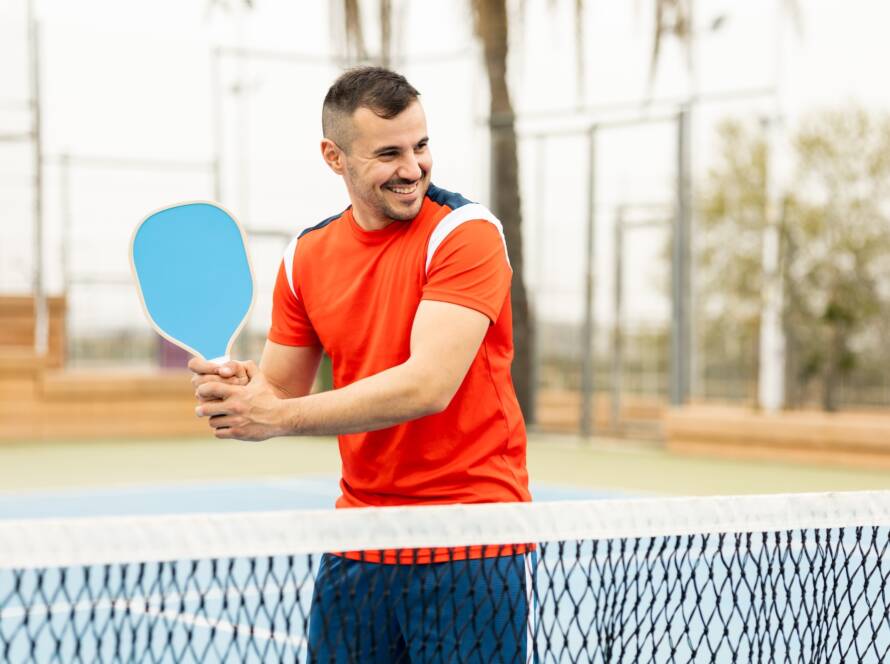
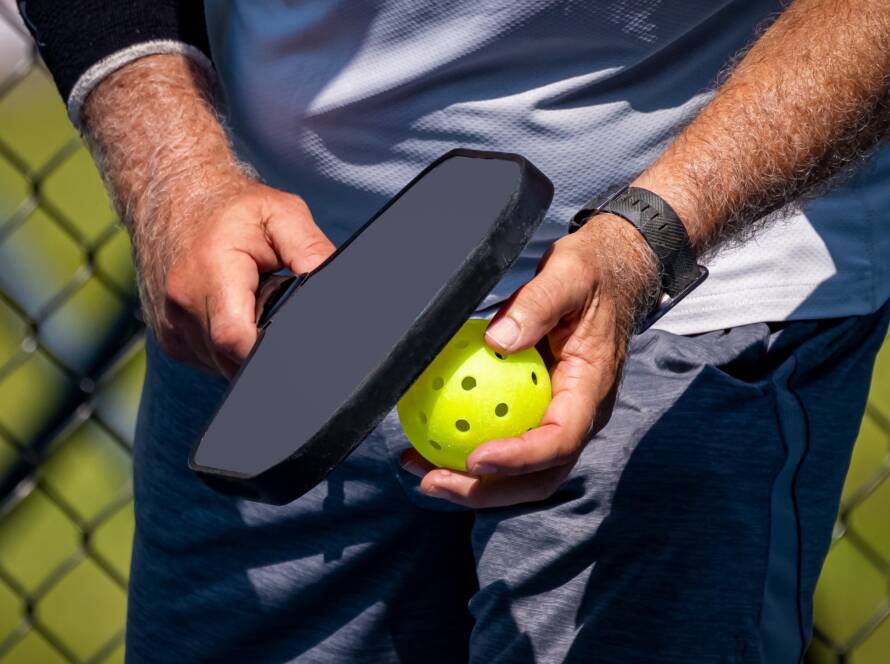
The fastest-growing sport in America isn’t tennis. It isn’t golf. It’s the game happening right now on the other side of the glass wall at PAC — and if you’ve played tennis, you already have most of the skills you need.
Both sports reward hand-eye coordination, quick reflexes, and a competitive spirit. But they deliver very different experiences, and choosing between them — or figuring out how to play both — comes down to what you actually want from your game. Here’s the honest comparison.
Court, Equipment, and Rules: The Key Differences
The most immediate difference between pickleball and tennis is scale. A standard tennis court spans 78 feet by 36 feet for doubles — roughly the footprint of a small house. A pickleball court is 44 by 20 feet, with a 34-inch net at center rather than 36.
Your equipment scales accordingly. A solid composite or graphite pickleball paddle runs 7–8 oz and costs $30–$150 for a quality beginner paddle, compared to $80–$250 for a strung tennis racquet. The ball is a lightweight, perforated plastic sphere — very different from a pressurized felt tennis ball in terms of speed and bounce.
Scoring differs too. Pickleball is typically played to 11 points (win by 2), and most recreational games wrap up in 15–20 minutes. One rule that surprises almost every tennis player: the non-volley zone, or kitchen — a seven-foot strip on each side of the net where you cannot volley the ball. Managing the kitchen is where pickleball’s real strategy lives.
Learning Curve: Which Sport Gets You Playing Faster?
Tennis takes time. Developing consistent groundstrokes typically requires months of lessons and regular practice before rallies feel natural. The larger court, heavier ball, and longer swing mechanics all extend the learning window.
Pickleball has a much shorter on-ramp. The lighter ball, compact court, and abbreviated swing mean most first-time players are sustaining real rallies within a single session. You still have plenty to master — soft resets, third-shot drops, and the dinking exchanges at the kitchen that define competitive play all take months to groove — but the early feedback loop is immediately satisfying.
Tennis players have a meaningful head start. Volleys, court positioning, hand-eye coordination, and net awareness all transfer directly. The main adjustments: shortening your backswing, resisting the urge to drive every ball, and learning patience at the kitchen line.
Physical Demands: Which Sport Is Harder on Your Body?
Both sports are genuine workouts, but they stress the body differently.
Tennis demands more aerobic output and explosive lateral movement. A 2023 Apple Heart and Movement Study comparing over 250,000 sessions found tennis players sustained higher average heart rates than pickleball players. If maximum cardiovascular intensity is your goal, tennis has the edge.
Pickleball is lower-impact. The smaller court means less explosive running and fewer hard plant-and-push movements on the knees and hips. For players managing joint issues — or coming back from tennis-related overuse — this matters. The shoulder mechanics are also gentler: pickleball’s compact swing puts far less strain on the rotator cuff than full tennis groundstrokes.
That said, pickleball is not a passive sport. Competitive kitchen exchanges require quick hands, excellent balance, and fast footwork. The injury profile is simply different — more emphasis on wrist and elbow stability, less on high-speed court sprints.
The Social Scene: Where Pickleball Has a Real Advantage
Here’s the dimension that surprises most tennis players who try pickleball for the first time: it’s a genuinely social sport in a way tennis rarely is, structurally.
Tennis often means two or four people booking a court together. Finding a regular doubles group requires effort — matching ability levels, overlapping schedules, and a reserved court. It’s achievable, but it demands coordination.
Pickleball defaults to four players, and open play formats mean you can show up at PAC solo, get matched immediately, and be in a game within minutes. The paddle-rotation format means you’re playing with and against new people throughout the session. At PAC’s nine indoor courts, there’s always a game running — early mornings, afternoons, and evenings.
The Bainbridge Lounge is part of this by design. Post-match conversation is built into the experience, and events like Dink and Drink Fridays make the social layer explicit. Tennis clubs can offer community too, but pickleball’s game structure makes it happen almost automatically.
Can Tennis Players Make the Switch — or Play Both?
Both, comfortably. Many PAC members do exactly that.
If you’ve played tennis seriously, expect your first few pickleball sessions to feel familiar and humbling at once. Your net game will be solid. Your court awareness will translate. But you’ll also likely overhit, struggle with kitchen patience, and find the third-shot drop genuinely foreign.
The reset — a soft, controlled shot that lands in the kitchen and neutralizes an aggressive opponent — requires touch rather than power. It’s a new vocabulary for most tennis backgrounds. A few sessions with one of PAC’s certified coaches can compress the adjustment period significantly.
Tennis players typically level up faster than pure beginners, and many find pickleball actually sharpens their net and reflex game when they return to the tennis court.
Pickleball or Tennis? How to Decide
Pickleball is likely the better fit if you:
- Want to play competitively within your first few sessions
- Value a social, community-oriented game structure
- Are managing a knee, shoulder, or hip issue from years of tennis
- Want flexibility — indoor courts, open play daily, no partner required
- Are new to racquet sports entirely
Tennis is likely the better fit if you:
- Have an established game you’re invested in developing further
- Want maximum cardiovascular intensity and court coverage
- Love the one-on-one dynamics of singles play
Consider playing both if you:
- Want variety — the sports genuinely complement each other
- Want to stay active through a tennis offseason or injury recovery
- Have kids who want a faster path into racquet sports
The fastest-growing sport in America is growing for a reason. Tennis players don’t have to leave their game behind to find out why.
Frequently Asked Questions
Is pickleball easier to learn than tennis?
For most beginners, yes. The compact court, lighter equipment, and shorter swing mean new players experience satisfying rallies much sooner. Advanced pickleball still has a high skill ceiling.
Is pickleball better for players with joint issues?
Generally yes. Lower-impact court coverage and gentler swing mechanics reduce joint stress, which is a major reason pickleball participation is especially strong in the 40–65+ demographic.
Can a tennis player pick up pickleball quickly?
Yes — volleys, court positioning, and hand-eye coordination all carry over. Expect a short adjustment around the kitchen game and a shorter backswing. Most tennis players are competitive within a handful of sessions.
Which sport burns more calories?
Tennis, at competitive levels, due to greater court coverage and higher sustained heart rate. Both provide meaningful aerobic benefits, and pickleball intensity scales substantially in competitive play.
Where can I try pickleball in Thousand Oaks?
PAC at 2000-B Anchor Court offers daily open play, beginner clinics, and DUPR-rated leagues across nine temperature-controlled indoor courts. No partner required — just show up.
Ready to Try It?
The comparison only goes so far. The fastest way to answer the pickleball vs. tennis question is to get on a court. PAC offers beginner-friendly open play daily and structured clinics for players at every level, including tennis crossovers.
Book open play or a beginner clinic at PAC and bring your tennis instincts. They’re more useful here than you think.